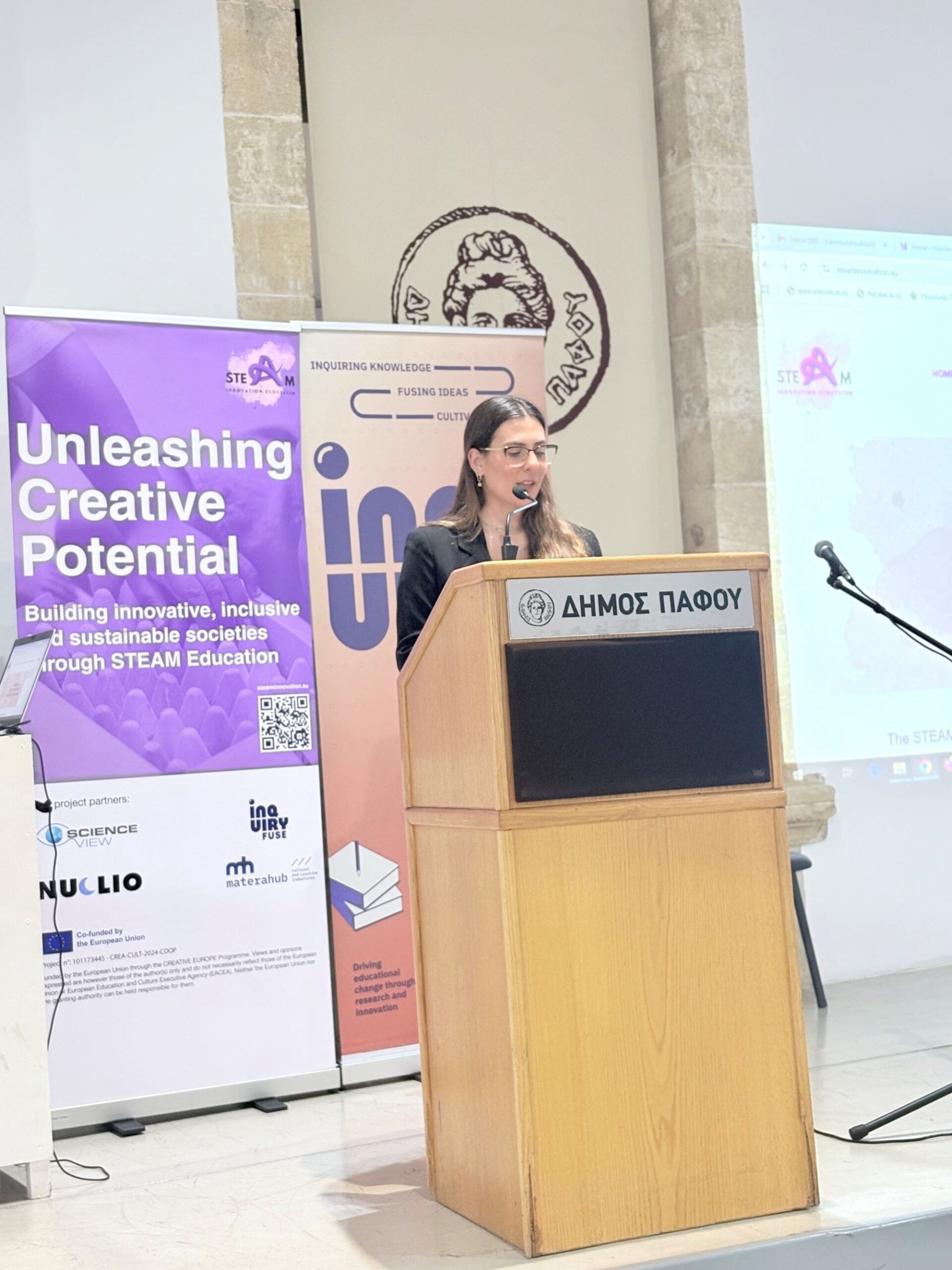
On the evening of 11 May 2026, the Paphos Municipality Hall filled with something unexpected: the sound of football statistics turned into piano melodies, planetary distances transformed into rock music, and plant growth rendered as a layered AI-generated composition. This was “The Sound of Science, Students Transform Data into Music”, the Cyprus national showcase event of the STEAM Innovation Ecosystem project, and it was an evening that nobody in the room is likely to forget.
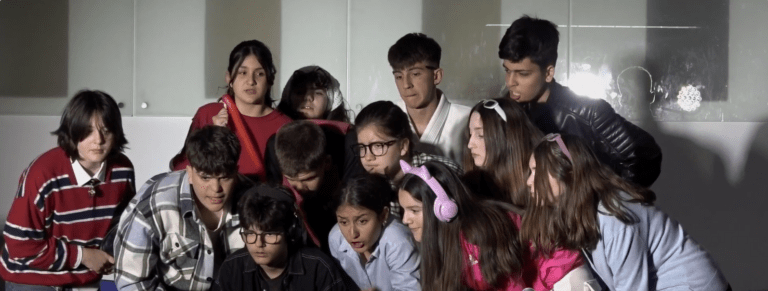
Around 50 people gathered for the event, students, parents, teachers, and invited experts, to witness the culmination of five months of work by four secondary school student teams from the Secondary School of Panagia Theoskepasti in Paphos. What they saw was not a school presentation. It was a genuine scientific and artistic performance, and the excitement in the room from the very first notes confirmed that something special was happening on that stage.
From Classrooms to the Stage
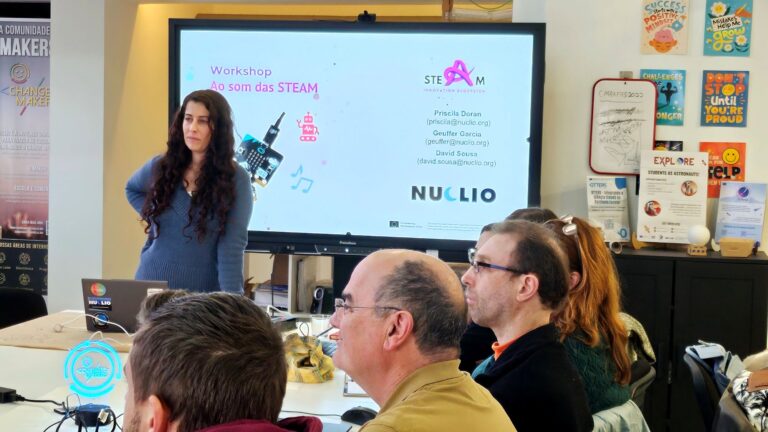
The four teams had been working since January 2026 within the framework of the Learning STEAM Through Music module of the STEAM Innovation project, an innovative European initiative co-funded by the Creative Europe Programme, bringing together organisations from Cyprus, Greece, Portugal, and Italy to explore what happens when science, technology, engineering, mathematics, and the arts are taught not as separate subjects but as a single, integrated creative language.
Over five months, the students, guided by weekly mentoring sessions, school visits, and one-to-one support from the Inquiry Fuse team, learned to collect and analyse real-world data, design systematic mapping rules linking numbers to musical parameters, and use tools including Python programming, AI music generation platforms, and digital audio software to produce original compositions. The result was four extraordinary projects, each telling a different scientific story through sound.
Four projects, four musical worlds
“Data Symphony: Nike vs Adidas” collected social media engagement data from two of the world’s most recognisable sports brands and mapped metrics such as likes, comments, and audience sentiment onto tempo, melodic complexity, and musical scale, Nike’s intensity becoming a fast, energetic composition, Adidas’s more balanced data becoming a smoother, emotionally stable piece, accompanied by AI-generated cinematic visuals.
“From Goals to Music” transformed thirteen years of football statistics for Lionel Messi and Cristiano Ronaldo into original MIDI compositions, each player given a distinct musical identity, Messi rendered through piano, Ronaldo through electric guitar and drums, through a Python programme the students built entirely themselves, without external libraries.
“The Music of Growth” observed the timelapse growth of a bean plant and a sunflower, extracted biological data on height, growth rate, and leaf density, and mapped each variable to a musical dimension, height to pitch, growth rate to tempo, leaf density to sound layering, producing two strikingly different AI-generated compositions that made plant biology audible.
“The Rhythm of Space, Artemis 4” mapped the actual distances of all eight planets from the Sun to musical frequencies, with inner planets producing high acute notes and gas giants producing deep bass, then layered sound design elements reflecting each planet’s physical character, culminating in a single unified rock composition in which the entire solar system plays together.
An evening of science, art, and genuine excitement
The opening of the event was delivered by Vasilia Philippou, Senior Project Manager at Inquiry Fuse, who welcomed the audience and introduced the STEAM Innovation project and its European dimension. The performances were evaluated by a distinguished panel: Vasilia Philippou and Dr Olia Tsivitanidou, Managing Director of Inquiry Fuse, alongside Professor Savvas A. Chatzichristofis, Professor of Artificial Intelligence and Vice-Rector for Research and Innovation at Neapolis University Paphos, whose presence underlined the genuine scientific ambition of what these students had produced.
The excitement in the room was palpable from the first performance to the last. Parents who had heard their children talk about data mapping and musical frequencies for months finally heard, and felt, what those words actually meant. Teachers who had accompanied the teams through the long months of development saw their students stand on a public stage with confidence and scientific maturity. And the students themselves discovered something that no classroom lesson could have given them: that data is not just numbers in a table, that science is not just a school subject, and that they are capable of making something original, rigorous, and genuinely beautiful from the intersection of the two.
Thank you
A warm thank you to the students of the Secondary School of Panagia Theoskepasti, whose curiosity, hard work, and creative courage made this evening possible. To their teachers, their ICT teachers, Mathematics teacher, Physics teacher, and music teacher consultant, whose openness to a new methodology was the foundation of everything. To the school leadership for their support throughout the process. To the parents who came, listened, and cheered. And to Professor Chatzichristofis for bringing the perspective of the research and innovation community to a room full of secondary school students who deserved that recognition.
The sound of science has rarely sounded this good.