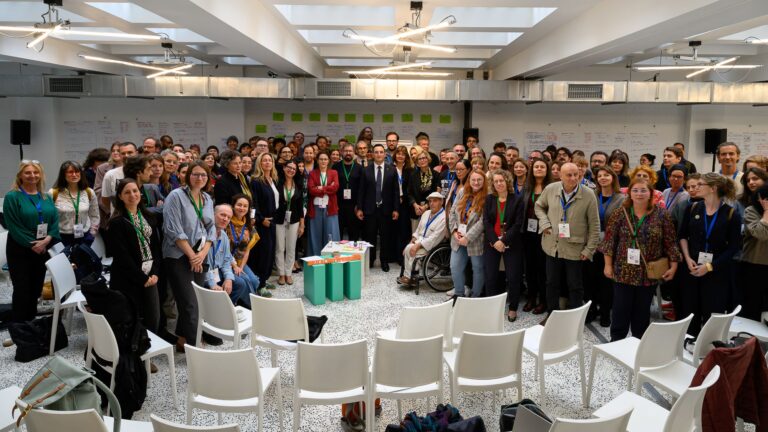
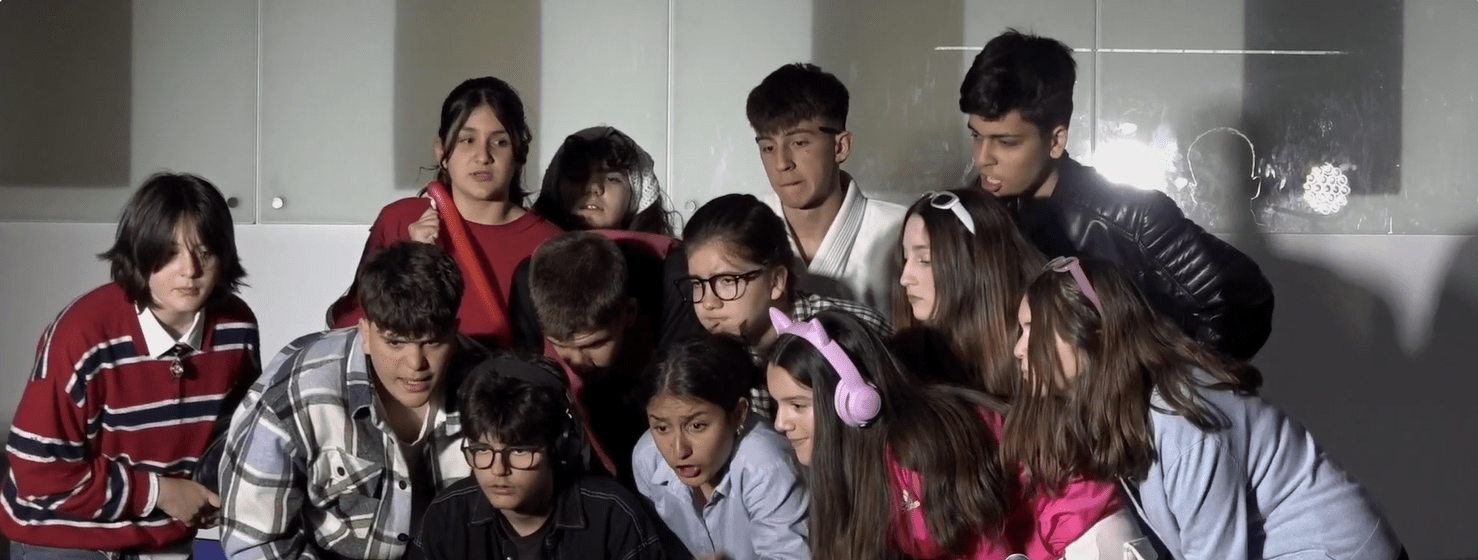
Across Greece, students turned scientific questions into stories, movement, music and public performance – making STEAM learning visible, collaborative and memorable.
|
27 SCHOOL TEAMS |
13 REGIONS |
600+ STUDENTS |
100 TEACHERS |
A structured pathway from inquiry to performance
Science View implemented the Learning STEAM Through Theatre module through the established Learning Science Through Theater (LSTT) ecosystem. Inquiry-Based Learning was combined with the Feel–Imagine–Create–Share Design Thinking approach and the wider Train–Create–Mentor–Disseminate pathway. Students began with a question and evidence, developed and revised a dramatic concept, and shared a completed performance with a real audience.
The central principle was demanding and simple: science had to drive the plot, characters, movement, sound and staging. It could not be an explanation added around a play. Body organs became characters, electric charges moved on stage, a robot was “debugged” in real time, and the Pythagorean theorem solved Romeo’s route to Juliet.
Theatre remained the main medium; music, choreography, robotics, video, scenography and maker tools were added where they deepened meaning. Roles in research, writing, direction, costume, sound, lighting, documentation and communication opened participation to students with different strengths—not only those who wanted to act.
HOW IT WORKED
1 TRAIN: Three national teacher workshops built a common foundation.
2 INQUIRE: Teams chose a theme, researched evidence and mapped the science.
3 CREATE: Students wrote, rehearsed, designed and revised their production.
4 MENTOR: Fifteen school-specific meetings addressed scientific and artistic needs.
5 SHARE: Live and online festivals completed the learning cycle with authentic audiences.
“The strongest projects made scientific relationships the engine of the story – not an interruption to it.”
GREECE • THE NATIONAL SCHOOL NETWORK
Different schools, one shared creative language
The network spanned primary, lower-secondary, upper-secondary and special vocational education. Schools from Attica and Thessaloniki to Kozani, Larissa, Patras, Zakynthos, Zacharo, Alexandreia and Rhodes adapted the same framework to their curriculum, timetable, resources and students. The 27 teams explored biology and health, physics, chemistry, astronomy, mathematics, energy and climate, artificial intelligence, robotics, technological evolution and the history of science.
PARTICIPATING TEAMS
| • 1st Junior High School of Argyroupoli | • Primary School of Kampos, Zakynthos “Panagiotis Chiotis” |
| • DIM.O.S. Junior High School of Kozani – Groups 1 & 2 | • Primary School of Zacharo |
| • Bougas Schools – Junior High School | • Experimental Primary School, University of Thessaloniki |
| • Junior High School of the Holy Metropolis of Piraeus | • Junior High School of Zacharo |
| • 3rd Junior High School of Glyfada | • Experimental Junior High School of Patras |
| • Ellinogermaniki Agogi – Primary School | • 1st Junior High School of Kaisariani |
| • Moraitis School – Primary School | • 7th Junior High School of Athens |
| • General Lyceum of Melissia | • Ursuline Greek-French School – Junior High School |
| • Model General Lyceum of Varvakeio School | • 3rd Junior High School of Argyroupoli |
| • 13th Primary School of Palaio Faliro | • General Lyceum of Agia Triada |
| • Primary School of Zarko | • E.E.E.E.K. Alexandreia – special vocational school |
| • 10th Primary School of Neapoli | • Music School of Larissa – Lyceum |
| • 4th Primary School of Tyrnavos | • 4th General Lyceum of Rhodes |
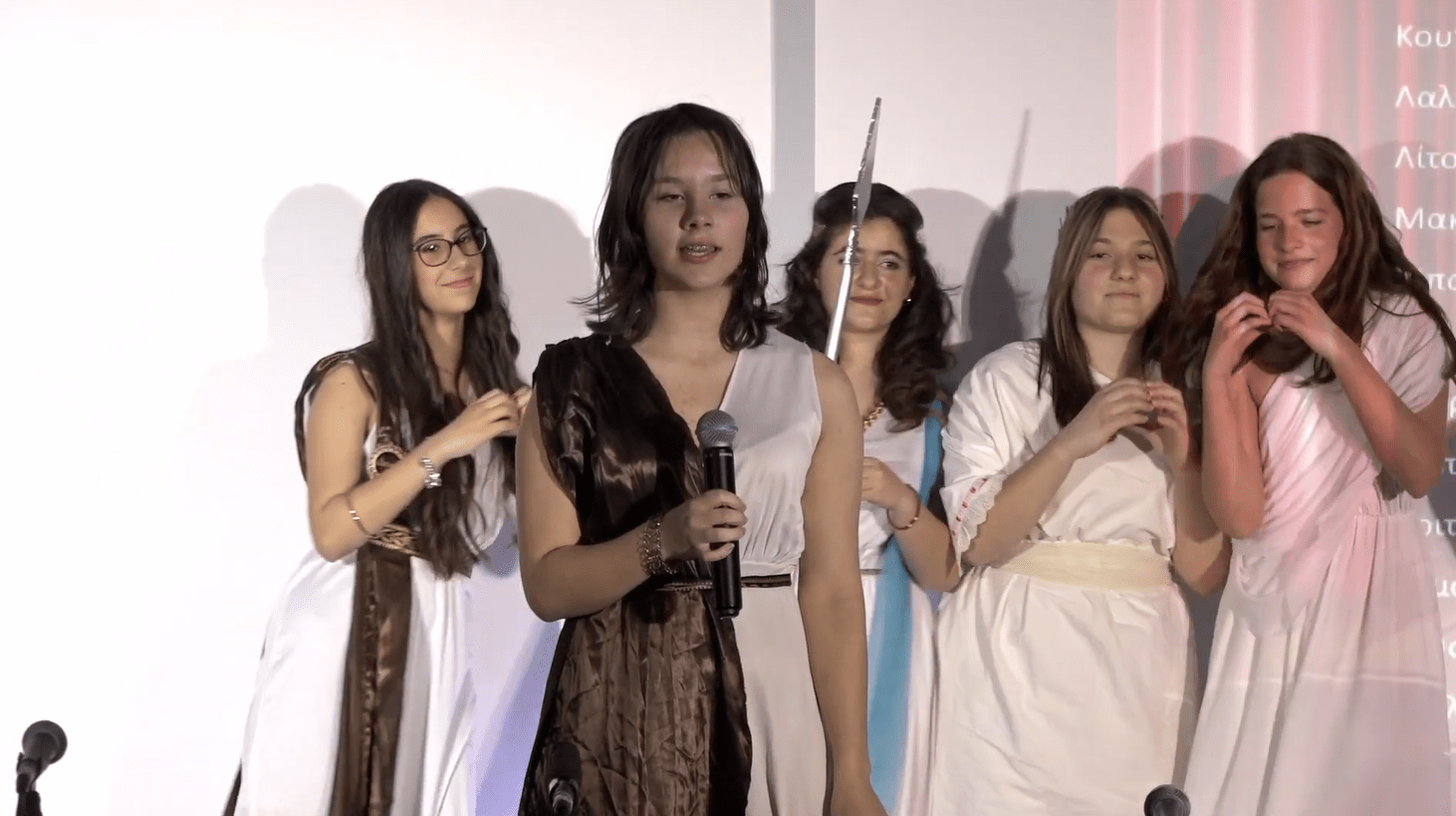
3rd Junior High School of Glyfada: ancient metallurgy becomes historical theatre. Photo: Science View. |
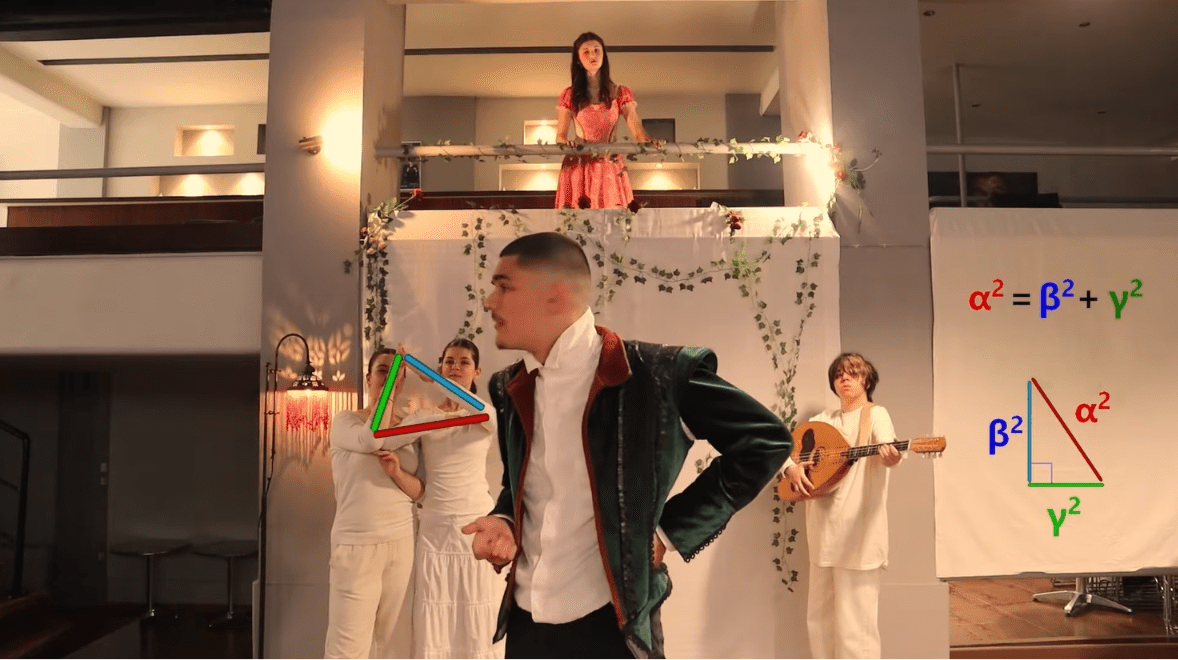
Music School of Larissa: mathematics, Shakespeare and live music meet on stage. Photo: Science View. |
What the evaluation suggests
| SCHOOL SELF-REFLECTION
53.8% → 72.2% All four participating Greek school units improved; the reported average gain was approximately +18.4 percentage points. |
STUDENT PRE/POST QUESTIONNAIRE
400 students · 4 gains Intrinsic motivation +0.27; career motivation +0.17; self-determination +0.26; self-efficacy +0.16. Grade motivation was stable (+0.02). |
Used in collaboration with the L-STEAM project, the Self-Reflection Tool helped four schools examine management, educational processes and teacher professional development, choose priorities and revisit progress after implementation. The student questionnaire used five science-motivation dimensions on a five-point scale. Read descriptively, the two evidence streams point in the same direction: stronger school conditions accompanied greater student interest, agency, confidence and future orientation. Grade motivation remained almost unchanged, suggesting that the distinctive value of theatre-based STEAM learning lay mainly in making science personally meaningful and participatory.
From local stages to a European platform
The Greek showcase culminated in the 12th LSTT Festival: live performances in Athens on 25–26 April 2026 and an online festival on 16–17 May. Three projects, by the 1st Junior High School of Argyroupoli, the 3rd Junior High School of Glyfada and the Music School of Larissa, were selected to represent Greece at the transnational festival in Matera. Their diversity captures the programme’s central achievement: a shared method that leaves room for every school, subject and student voice to create something genuinely its own.